Buying tool steel for large dies requires more than comparing grades and prices. For stockists and distributors, the quality of a large steel block can affect multiple customer orders after the material is cut. Inconsistent hardness, internal defects, unsuitable dimensions, or missing documentation can create problems long after the original purchase.
When purchasing 1.2714 tool steel, buyers should therefore consider the complete supply chain, from forging and heat treatment to ultrasonic testing, certification, traceability, and final dimensions. These factors become especially important when large-section material is purchased as a mother block and later divided into smaller pieces for resale.
Choose Practical Stock Sizes
Large tool steel blocks can represent a significant investment. Stockists need sufficient flexibility to serve customers without filling their warehouses with oversized or slow-moving material.
Instead of automatically purchasing the largest blocks available, analyze the die sizes customers typically request. Previous sales records can help identify the dimensions that move most efficiently. Saw-cutting patterns should also be considered because poor size planning can result in excessive waste and expensive leftover pieces.
For high-value large sections, the difference between an efficient and inefficient purchasing strategy can have a substantial effect on working capital. The objective should be to maintain useful inventory while minimizing unnecessary cutting loss.
Control Delivery Hardness
1.2714 tool steelis commonly supplied in quenched-and-tempered conditions. Pre-hardened material may typically be supplied around 37–41 HRC, although the required hardness should always be established according to the intended application and customer's specifications.
A buyer should not rely solely on the term "pre-hardened." The purchase specification should clearly state the required hardness range and how the hardness will be verified.
This is particularly important for thick blocks. Heat treatment can behave differently across large sections, and a hardness reading taken from one accessible surface does not necessarily describe the entire block.
For stockists, consistency is valuable because a mother block may eventually be divided among several customers. Maintaining predictable properties throughout the section helps reduce the risk of receiving complaints from customers who purchase different pieces of the same original block.
Specify UT Requirements Before Buying
Internal quality is another important consideration when purchasing large-section tool steel. Simply describing a block as "UT OK" does not provide enough information for demanding applications.
For critical stock, buyers should agree on the ultrasonic testing standard and acceptance level before production begins. SEP 1921 is commonly used for the ultrasonic inspection of forged tool steels, with appropriate acceptance classes selected according to the application.
A practical purchasing specification should clearly identify:
- The applicable ultrasonic testing standard.
- The required acceptance class or level.
- The relationship between the inspection report, heat number, and individual block.
This documentation becomes particularly valuable after a mother block has been cut. If a customer later discovers an internal indication, the distributor needs to determine exactly which heat and block the material came from and whether other pieces from the same source may require investigation.
Check the Forging Route
The chemical composition and hardness of 1.2714 tool steel are important, but they do not tell the complete story of how large-section material was produced.
Heavy forging can help work the original cast structure and improve internal consolidation and structural uniformity. This becomes increasingly relevant as section thickness increases because the center of a large block can be more challenging to process uniformly.
When purchasing large stock, ask the steel manufacturer about the production route. Useful information can include the starting material, forging equipment, forging reduction, heat-treatment process, and final inspection procedures.
Two blocks can meet the same chemical requirements and have similar hardness values while having different manufacturing histories. For distributors who cut and resell material from large blocks, understanding that history can be important for maintaining consistent inventory quality.
Keep Traceability After Saw Cutting
A heat number is valuable only when its connection to the material is maintained throughout the distribution process.
The original mother block should be connected to its material test certificate, hardness records, ultrasonic inspection report, and heat number. Once the block is saw-cut, each resulting piece should retain an internal identification system that allows the distributor to trace it back to the original documentation.
A practical traceability chain looks like this:
Cut Piece → Mother Block → Heat Number → MTC → Hardness & UT Records
This system can become extremely useful if a customer reports an issue months after delivery. Instead of investigating the entire inventory, the distributor can identify the relevant heat, retrieve the associated inspection records, and determine whether other pieces from the same material require attention.
Traceability should survive the saw cut.
Match Stock to Customer Requirements
Not every piece of 1.2714 tool steel in a warehouse will automatically meet every customer's requirements.
Before shipping, the distributor should compare the order specifications with the original mill documentation. Important factors can include hardness, ultrasonic acceptance level, dimensions, surface condition, and delivery condition.
For example, material that was originally inspected according to one UT acceptance level should not automatically be presented as meeting a stricter requirement simply because it carries the same steel grade designation.
Complete documentation helps stockists understand exactly what each piece can be supplied for. This makes it easier to match inventory with applications and avoid unnecessary claims or returns.
Work With a Reliable Tool Steel Supplier
Choosing a reliable tool steel supplier is an important part of purchasing large dies material. For stockists, supplier quality should be measured not only by purchase price but also by production consistency, inspection capability, documentation, and traceability.
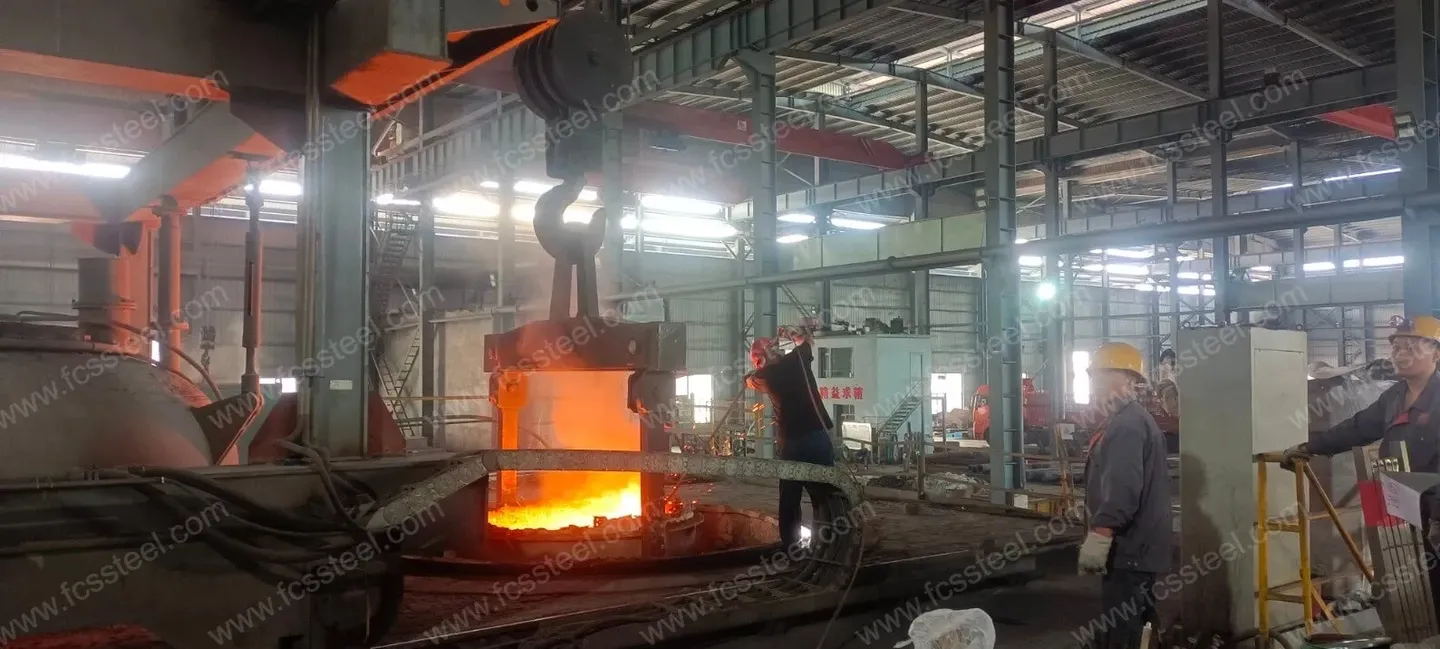
FCS Steel states that its large-section tool steel production includes LF refining and VD vacuum degassing, followed by heavy forging and controlled heat treatment. The company operates a 5,500-ton forging press and states that a forging ratio of at least 5:1 can be achieved for sections above 500 mm where applicable.
Depending on order requirements, inspection may include chemical analysis, hardness testing, ultrasonic testing according to the specified acceptance level, and metallographic examination. Heat-number and MTC 3.1 traceability help connect the inspection records with the supplied material.
For distributors, this type of documentation can remain useful even after a large block has been divided into smaller pieces and sold to different customers.
Consider the Complete Cost of the Purchase
The lowest price per ton does not necessarily represent the lowest overall inventory cost.
When purchasing large blocks, consider:
- Material price
- Required dimensions
- Saw-cutting losses
- Transportation
- Inspection requirements
- Certification and documentation
- Warehouse space
- Potential rejection or return costs
- Customer-specific requirements
- Long-term traceability
A small saving at the purchasing stage may become insignificant if the material later requires additional inspection, produces excessive waste, or results in customer claims.
For expensive large-section steel, purchasing decisions should therefore focus on total value rather than price alone.
Buy for Resale, Not Just for Storage
A stockist should evaluate every large 1.2714 purchase according to how effectively it can be converted into future customer orders.
The ideal inventory combines practical dimensions, consistent hardness, appropriate internal quality, reliable documentation, and traceability. These characteristics allow the distributor to respond to different customer requirements without repeatedly investigating the origin and condition of each piece.
Before placing an order, establish the requirements that matter most to the target market. Confirm the steel grade, delivery condition, hardness range, UT standard, acceptance level, dimensions, inspection requirements, and documentation.
This approach can make inventory easier to manage and reduce uncertainty when the original mother block is eventually divided.
Final Considerations
Buying 1.2714 tool steel for large dies requires careful attention to more than chemical composition. Section size, forging quality, heat treatment, hardness consistency, internal soundness, inspection standards, and traceability can all influence the usefulness of the material.
For stockists and distributors, these considerations become even more important because one large block may eventually become several separate customer orders. A problem discovered in one piece can raise questions about other pieces from the same heat or mother block.
The purchasing process should therefore begin with clearly defined specifications and continue through production, inspection, cutting, storage, and resale.
The cheapest steel per ton is not necessarily the lowest-cost inventory. A rejected block, excessive cutting waste, or multiple customer claims can quickly eliminate an initial price advantage.
By selecting suitable dimensions, verifying hardness and internal quality, maintaining complete traceability, and working with a reliable supplier, distributors can build a more dependable inventory of 1.2714 tool steel for large-die applications.